

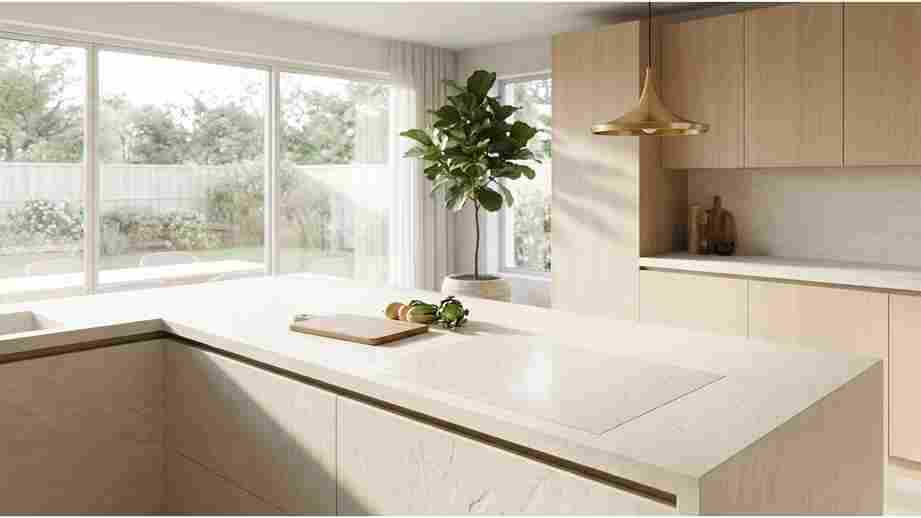
Laminam Porcelain Countertop: Italian Technology and Ecesoy Engineering
If you’ve embarked on a kitchen renovation, you’ve probably heard a hundred thousand ideas from all directions. One person comes along and says, “get marble,” another advises, “get quartz and relax.” But in the end, you’re always the one who suffers with those stones. Two drops of lemon on marble, and the stone is eaten away. You put a hot pot on quartz, and its resin burns and yellows. As a craftsman who has dealt with these problems in workshops and construction sites for years, let me tell you the truth: If you want peace of mind in the kitchen and don’t want to deal with stains or heat, the material you should look at is porcelain. One of the best representatives of porcelain in the world is Italian Laminam. So, is this Laminam porcelain countertop really as durable as they say? Let’s talk about the technique behind the countertop and the secret to proper installation, without beating around the bush.
Italian Laminam 12+ Features and the Power of Fiberglass Behind It
There are many porcelain brands on the market, but there’s a very important technical detail that sets Laminam apart. They’ve put something revolutionary at the top of the Laminam 12+ features: fiberglass mesh reinforcement on the back surface of the stone.
The truth is this: they adhere a glass fiber (fiberglass) mesh to the back of this 12mm thick porcelain slab using a special technology. What does this mesh do? It adds incredible flexibility and shock-absorbing power to the stone. So, when a hard impact comes from above onto the countertop, or when the stone flexes during transport, that mesh on the back absorbs the energy of the impact. It prevents the stone from shattering.
On top of that, they apply a special surface treatment they call “Ambiance.” This allows the material to directly enter the antibacterial countertop class. There isn’t even a single micropore on the stone. What does zero porosity mean? Red wine spills, olive oil is forgotten, or a tea stain remains… It doesn’t matter at all. Not a single drop of liquid can seep into the stone. You just wipe it with a wet cloth, and it remains sparkling clean like the first day. Since it has an international food contact certificate (NSF), you can comfortably chop your vegetables and meat on it without looking for a cutting board. No knife marks will be left either.
Why Do Porcelain Countertops Crack? Zero Risk with Ecesoy Engineering
Here, I need to give you an honest craftsman’s warning. Even if you bring the world’s best porcelain from Italy, if the underlying infrastructure is trash, that countertop will crack.
Why? The situation is very simple. Porcelain is very hard but does not flex. You place the porcelain on top of kitchen cabinets, and you throw in two flimsy wooden strips in between. Over time, those cabinets fill with heavy pots and pans, and the wood sags. The underside of the countertop remains hollow. Then, when a heavy pot suddenly drops on it, the porcelain, being hollow underneath, cannot flex and cracks. Then the user goes online and types “porcelain countertop cracked.” What is the stone’s fault? The fault lies with the craftsman who left the underside hollow.
How do we solve this risk at Ecesoy Yapı?
Let me not beat around the bush: We fill the underside completely. We cover the underside of the 12mm Laminam slab not with flexible wood or anything like that, but with precisely processed solid natural marble. In other words, we lay a marble bed under the porcelain. Zero gaps, zero flexing. Whatever you hit the countertop with, the impact energy transfers to the marble underneath and is absorbed. The stone does not move. The risk of breakage ends.
We don’t leave the edges rough either. We cut a 45-degree miter joint with our 5-axis CNC machine in the factory. The joint comes out razor-sharp. The stone looks as if it were a single, thick solid block.
Mat Textures and Warm Minimalism in the Kitchen
As for aesthetics… The old, eye-straining, glossy marbles with exaggerated veins bursting from everywhere are out of fashion. People are looking for calmness and serenity in their homes.
Laminam models like Talco or Calce Antracite are exactly in this vein. They have a plaster-like, matte, and raw texture. They don’t reflect light or strain the eyes. When placed alongside wooden cabinets, they add tremendous warmth to the kitchen. They neither look artificial nor scream “I’m here.” It’s truly a master’s work, a simple and noble stance.
Come Have Tea with Us in Ataşehir
Don’t get too caught up in online ads or fancy brochures. A stone is best understood by touching it with your own hands.
Come to our central warehouse in Ataşehir. Feel this Italian porcelain with your own hands. Examine its texture, see its durability with your own eyes. Let’s sit down for a cup of tea, give us your kitchen measurements, and we’ll provide you with a clear price.
You can reach us anytime via our email address [email protected] or our WhatsApp line +90 530 935 00 38. Entrust your kitchen to the true craftsmen of the trade, without seeking adventure.